“Raising East Africa’s audio standard, one cohort at a time.”
Across Uganda and East Africa, creative talent is not in short supply. Musicians, filmmakers, storytellers and content creators fill every city, town and district. What limits how far that talent travels is often not passion, it is sound quality: poor dialogue clarity, uncontrolled noise, weak mixing and inconsistent loudness that quietly undercut otherwise powerful stories and music.
Quad-A Academy, through the Bayimba Foundation and in partnership with the Mastercard Foundation, is addressing that gap directly. In 2026 the Academy is delivering the Certificate in Audio Production & Post-Production (CAPP), a fully structured, industry-aligned programme based in Mbale, Uganda, built to equip grassroots young people with professional audio skills that meet international broadcast standards.
About the Programme
CAPP is a three-month intensive programme running March to August 2026, with graduation in September. Learners move through six sequential cohorts, Monday to Saturday, 9:30am to 5:30pm. It carries 20 credit units across five core modules and more than 290 contact hours, structured the way real audio production work unfolds: field-based listening and sound theory first, then digital editing, Foley and sound design, mixing, mastering, and a full integrated final project.
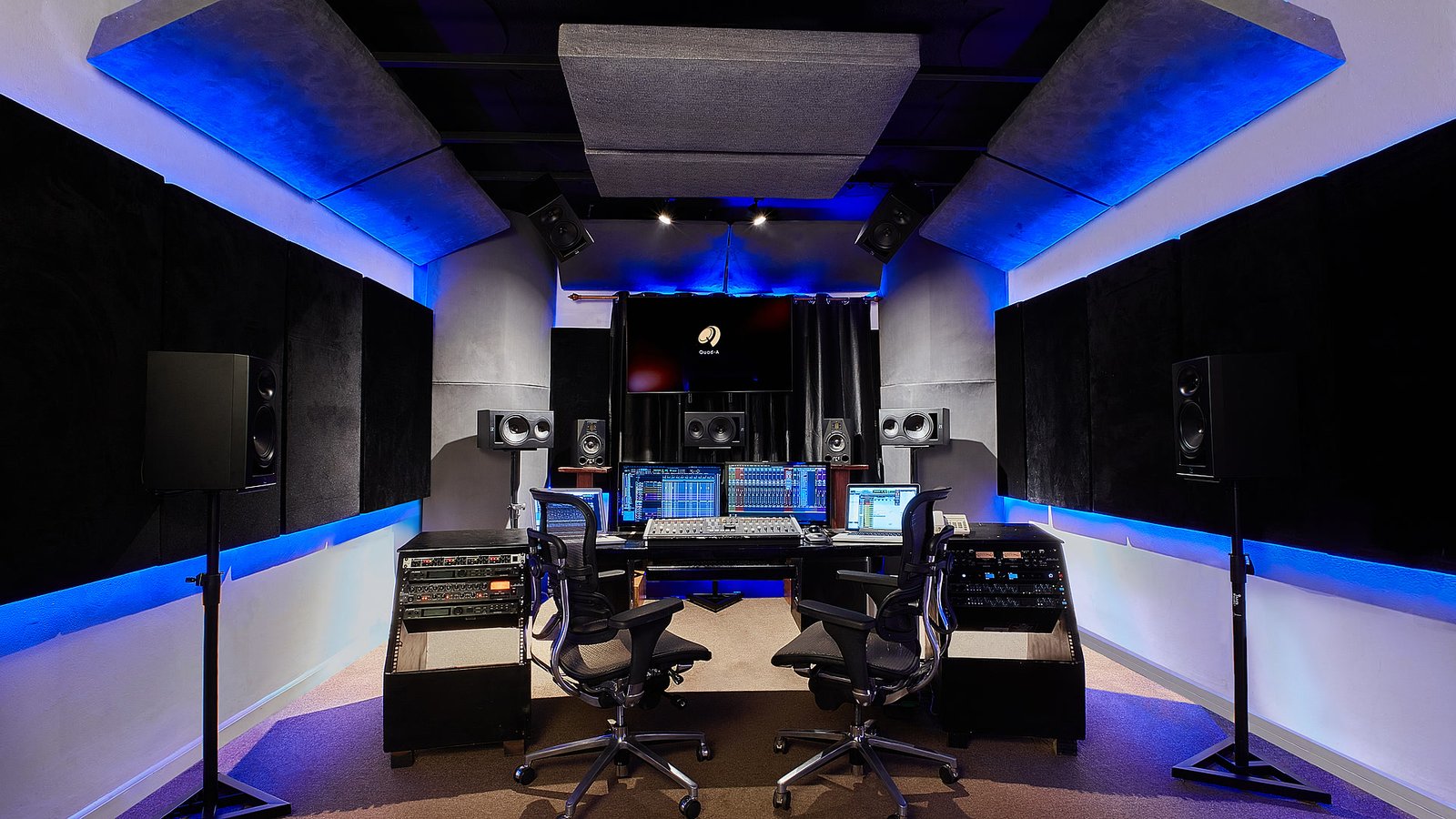
Delivery runs from Quad-A Academy in Mbale with site visits, field recording excursions and studio simulation sessions woven through the timetable, alternating onsite instruction, online learning and practical labs.
Who It's For
CAPP is built for people aged 18 to 35 with a passion for sound, music, film or storytelling who have never had access to formal technical training. There is no minimum academic requirement. The only admission requirement is a two-minute audio sample, recorded on any device the applicant has to hand, even a phone. It is not a skills test, it simply confirms genuine interest in sound.
Priority goes to financially disadvantaged young women from marginalised communities, including persons with disabilities and refugees, focused on Mbale and the surrounding districts of Eastern Uganda where the Mastercard Foundation partnership is targeted.
The Five Modules
- CAPP-101 · FOUNDATIONS & SOUND THEORY: frequency, amplitude, the decibel scale and psychoacoustics. Week one is entirely field-based, no laptops, no screens, just listening and documenting how sound behaves in real spaces.
- CAPP-102 · AUDIO EDITING & POST-PRODUCTION: dialogue editing, noise reduction, ADR sync, Foley performance and sound design for picture, built around Avid Pro Tools and real production scenarios.
- CAPP-103 · FIELD RECORDING & SOUND FOR PICTURE: boom operation, lavalier placement, room treatment and capturing clean audio in uncontrolled locations.
- CAPP-104 · MIXING, MASTERING & MUSIC INTEGRATION: the full mixing chain from gain staging through loudness-compliant, delivery-ready masters against EBU R128, Netflix, YouTube, Apple Podcasts, Spotify and cinema DCP specs. The final day assembles a complete film scene mix from scratch.
- CAPP-105 · FINAL PROJECT & EMPLOYABILITY: a portfolio-ready capstone project, alongside digital and financial literacy sessions delivered by Steadman Global Consulting every Friday.
How Learning Happens
CAPP runs on a competency-based model: learners progress by demonstrating skill, not by passing theory exams alone. Assessment is built around what they can actually produce and deliver, recorded sessions, edited dialogue, mixed stems and a curated portfolio. Each day follows a consistent structure, session blocks, vocabulary building, hands-on practice, an exit assessment and a preview of the next day's work, taught in plain, accessible language with no assumed prior experience.
Certification
- Attend at least 80% of all programme sessions
- Complete every assessment: weekly tasks, a mid-course test, a portfolio and the final project
- Score 60% or above across all modules
- Submit a curated portfolio demonstrating the full production workflow
- Demonstrate professional conduct, ethics and teamwork throughout
The certificate is jointly issued by Quad-A Group and marks a graduate's readiness for professional studios, post-production houses and freelance work.
After CAPP
Graduates leave with a portfolio, a practical skill set and a professional network. High performers are recommended for internships and industry attachments coordinated through Bayimba Foundation and NextCom, with placement partners including DW, VOA, Swangz Avenue, MCI, Bakash Media, Victoria University and Makerere University. For those choosing to freelance, CAPP builds the business literacy to price work fairly and manage clients professionally. Outcomes are tracked at three and six months post-graduation.
The Training Team
- Andrew Ahuurra · Academic Director & Foundations Lead (CAPP-101)
- Adnan Ssenkumba · Post-Production Lead (CAPP-102)
- Paul Kazibwe · Creative & Field Recording Lead (CAPP-103)
- Isaiah Mucunguzi · Music Integration Lead (CAPP-104)
- Ssemujju Isima · Professional Practice Lead (CAPP-105)
- Amulen Rebecca · Field Recording Support, Boom & Lavalier
- Isiko Abubaker · Foley & Dialogue Support
- Kyle Simbwa · Studio IT & DAW Technical Support
This programme is made possible through a partnership between Quad-A Group Limited (curriculum and delivery), the Bayimba Cultural Foundation (implementing partner) and the Mastercard Foundation (principal funder), part of a wider push for gender-inclusive skills development and entrepreneurial growth in Uganda's creative economy.
CAPP 2026 is underway. Graduation is in September 2026.
MORE FROM NEWS & UPDATES